Introduction
Where are we going, and why?
When a government makes promises to Indigenous peoples, who decides what happens to the land and the water, and how can citizens check whether those promises are kept?
Why this unit?
Dams, pipelines and reservoirs bring energy and money to Canada. Many of them are on land and rivers where First Nations, Inuit and Métis have lived for thousands of years. Since 1969, Canadian governments have made many promises to Indigenous peoples: some were kept, some were broken, and some are still on the table.
In this unit, you will look at two works of art, watch real interviews and news reports, read official figures and check them. You will always look at both sides: what was done, and what was not done.
How we work in this unit
- We talk about real people and real communities. We use the names that peoples give themselves: the Cree of Eeyou Istchee, the Inuit of Nunatsiavut, the Wet’suwet’en.
- Every figure comes with its source. If you use a figure, you give its source too.
- People in the same community can disagree. We listen to every voice with respect.
Your road map
At the end of this unit, you will be able to: describe a work of art and make hypotheses, read the symbolism of a Woodland painting and explain why nature and the land often hold a sacred place in Anishinaabe and other First Nations cultures, report a promise and judge it, use the passive to explain what was done, compare figures with precision, defend a point of view in a role play and in a hearing, and write an open letter.
Grammar page
Two tools for the whole unit: promises, kept and broken, and the passive. You will use it in Sessions 2 and 6.
Open the grammar pageAdapted grammar pageSession 1: Look Before You Judge
A village, a loon and a fish, and a sacred bond with the land.
Recap
What do you already know about Canada? Answer quickly, in English.
- What are the two official languages of Canada?
- What is the capital of Canada?
- Who were the first people to live on the land that is now Canada?
Answer key
- English and French.
- Ottawa.
- Indigenous peoples. Today the Constitution recognises three groups: First Nations, Inuit and Métis.
Look at Jim Logan’s painting 15 min
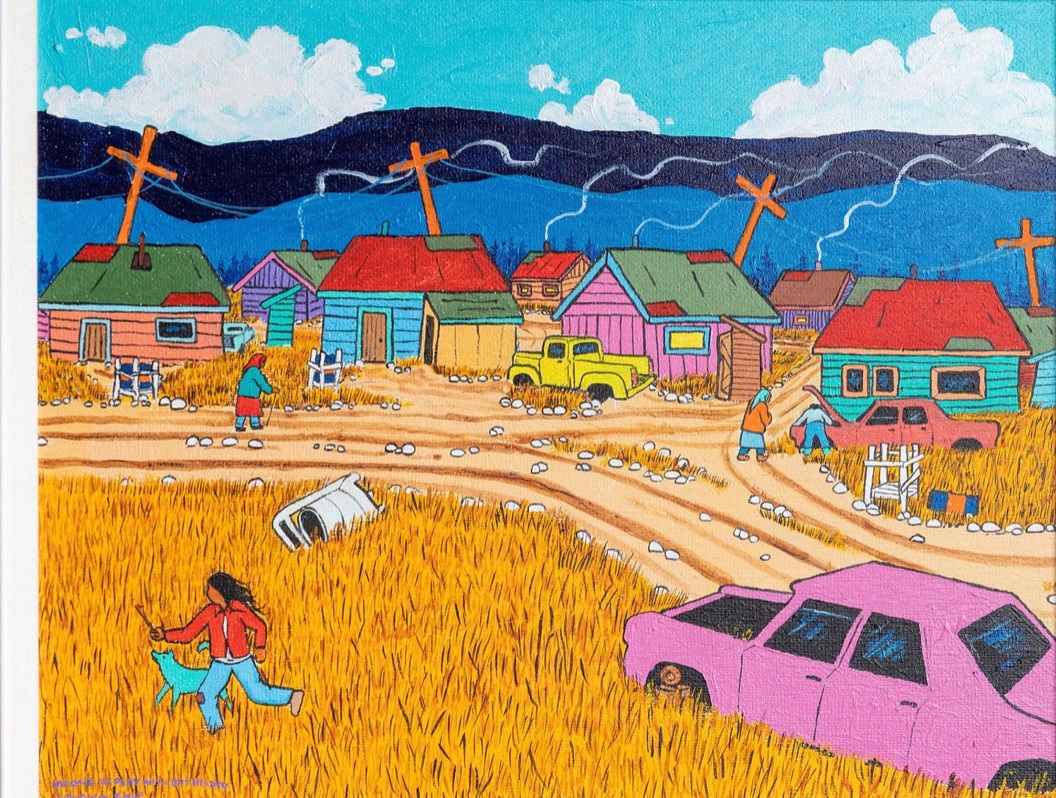
Look at Jim Logan’s painting at the top of the page (the second painting, under Morrisseau). Cover its caption with your hand: do not read the title yet.
- What can you see in the foreground? In the background? On the right?
- What is the boy doing? Who is with him?
- Where do you think this village is? Why?
- What seems to be missing in this village?
- In the foreground, I can see… In the background, there are…
- In the bottom right-hand corner, there is…
- The village might be in the north of Canada, because…
- There must be… / There can’t be…, because…
- What strikes me is that nobody…
Answer key
In the foreground, a boy with long black hair and a red jacket runs through tall yellow grass with a blue dog. On the right, there is an old pink car with no wheels, and a white object is lying in the grass. In the background, there are small wooden houses painted in bright colours, electricity poles, smoke coming out of the chimneys, a yellow pick-up truck and dark blue hills.
The village might be in the north of Canada: the houses are small, the roads are dirt roads and the smoke suggests that it is cold. Nobody is playing with the boy. The other people are adults, and they are working or walking. Possible answers to question 4: other children, a playground, a school, a shop, paved roads. All hypotheses are welcome if you justify them.
The title and the artist 10 min
The title of the painting is No One to Play with but his Dog. Does it confirm your hypotheses?
Jim Logan
Jim Logan was born in 1955 to a Métis family in Port Coquitlam, British Columbia. He spent time with the Kwanlin Dün First Nation, near Whitehorse, in the Yukon, and he later worked as the Indigenous curator of the Art Gallery of Nova Scotia. He calls himself “a social statement artist”.
- What is a “social statement artist”?
- Which word does Jim Logan put in inverted commas? Why, in your opinion?
- Does the painting look sad or happy? Can it be both?
Answer key
- An artist whose work says something about society and its problems.
- “reconciliation”. He seems to ask what the word really means, and whether reconciliation is possible.
- Both answers are possible: the colours are bright and the boy is running, but he is alone and the village looks poor.
Sources: Canada Council Art Bank, Dialogues with Jim Logan, 2024
Key facts: the First Peoples of Canada 10 min
- First Nations
- Many different nations, such as the Cree, the Anishinaabe or the Wet’suwet’en. Many First Nations people live on reserves: land set apart for a First Nation under the Indian Act, with an elected band council.
- Inuit
- The Indigenous people of the Arctic, for example in Nunavut or in Nunatsiavut, in Labrador.
- Métis
- A distinct people, with its own history, culture and language.
According to the 2021 Census, more than 1.8 million people in Canada identify as Indigenous: 5 per cent of the population. The three groups are “distinct peoples with unique histories, languages, cultural practices and spiritual beliefs”.
Section 35 of the Constitution Act, 1982 recognises the rights of the “Indian, Inuit and Métis peoples of Canada”.
Treaty land or unceded land?
In much of Canada, the Crown signed treaties with First Nations: treaty land. In British Columbia, most of the land was never ceded or surrendered by treaty: it is unceded land. This difference will be important in Sessions 4 and 5.
- What are the three Indigenous peoples recognised by the Constitution?
- What is the difference between treaty land and unceded land?
Answer key
- First Nations, Inuit and Métis.
- Treaty land was the subject of a treaty between the Crown and a First Nation. Unceded land was never given up by treaty.
Sources: Justice Laws, Constitution Act, 1982, section 35 · Crown-Indigenous Relations and Northern Affairs Canada, Indigenous peoples and communities · CBC News, 2020, unceded land in British Columbia
Anishinaabe art: lines of communication 10 min
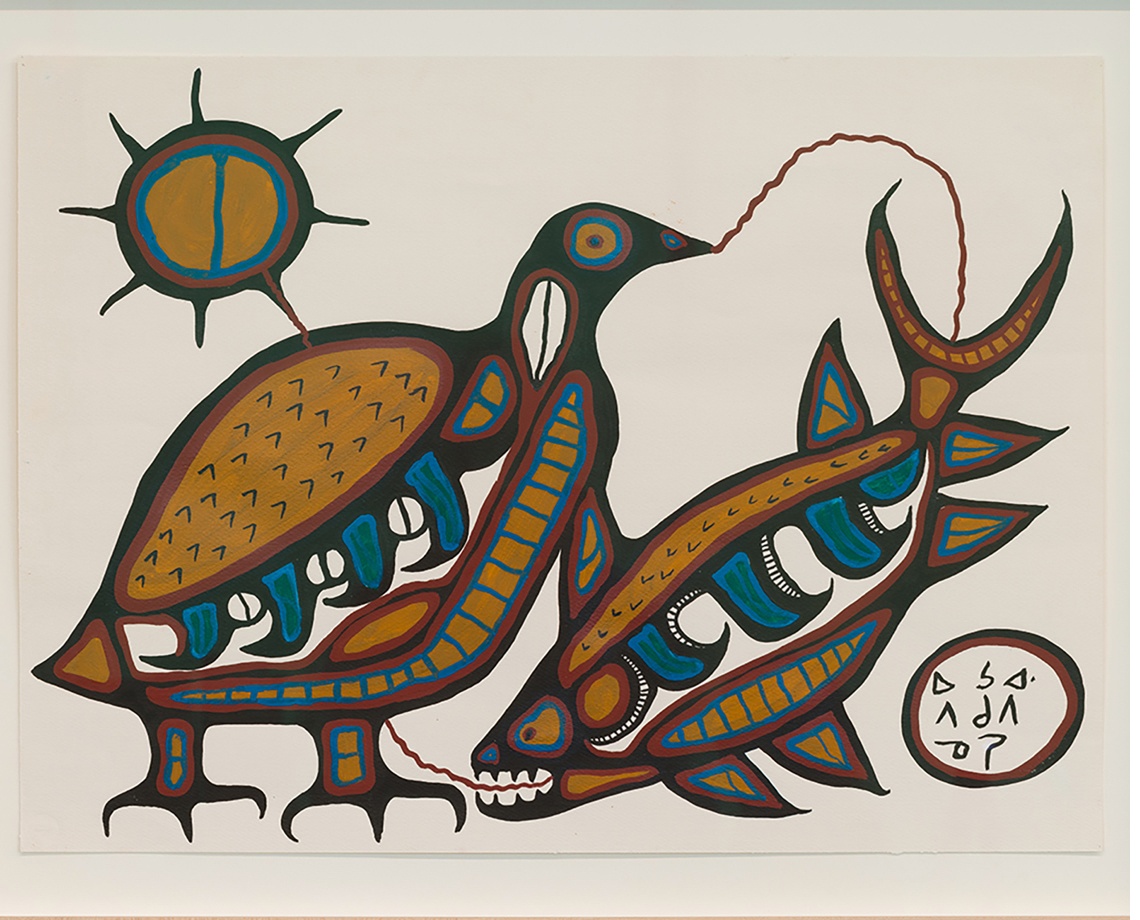
Norval Morrisseau is known as the creator of the Woodland School of art. His paintings use heavy black outlines, bright colours, and an “x-ray” view that shows the inside of animals. The Art Canada Institute explains that his “lines of communication” join animals and people: “They mark relationships”.
- Describe the painting: what is in the top left-hand corner? In the bottom right-hand corner?
- Follow the red lines. What do they connect?
- What might these lines mean about land, water and living things?
- Compare with Jim Logan’s painting: which one shows people, which one shows a link with nature?
- The lines might show that…
- It must be a message about…
- Unlike Jim Logan’s painting, this one…
Answer key
- In the top left-hand corner, there is a sun. In the bottom right-hand corner, there is a circle with a signature in syllabics. A loon is on the left and a fish is on the right.
- One line connects the sun and the loon, and another one connects the loon and the fish.
- Possible answer: the sun, the bird and the fish depend on each other. The water, the animals and the people who live from them are connected.
- Jim Logan shows a village and people; this painting shows animals and their relationships. Both say something about life on the land.
Sources: Art Canada Institute, Norval Morrisseau, Style and Technique · The Canadian Encyclopedia, Norval Morrisseau
Expanding your vocabulary 5 min
| Word | Meaning | Example from this session |
|---|---|---|
| kinship | a family-like bond between beings | Many Anishinaabe teachings speak of kinship with animals and the land. |
| a living relative | someone (or something) treated as family, not as an object | Rivers may be spoken of as living relatives. |
| sacred | worthy of deep respect, almost spiritual | A place can be sacred even if it is not a building. |
| interconnection | the idea that all living things are linked | The red lines may suggest interconnection. |
| an X-ray style | showing the inside of a body as well as the outside | Woodland art often uses an X-ray style. |
| lines of communication | lines that join figures and "mark relationships" (Art Canada Institute) | Morrisseau's lines of communication join the sun, the loon and the fish. |
| a resource | something used for money or energy | A river seen only as a resource can be dammed for power. |
| stewardship | caring for the land for those who come after us | Stewardship looks to future generations. |
Observe: what the painting puts in relation 8 min
Look again at Morrisseau's painting. Stay with what you can see before you interpret.
- Name the beings and the elements you can see (bird, fish, sun, lines, signature).
- Where do the red lines start and end?
- What does the "x-ray" view let you see inside the loon and the fish?
- What is written in the circle in the bottom right-hand corner, and in which writing system?
Answer key
- A loon (a water bird), a fish, a sun with rays, red lines, and a circular signature.
- One line joins the sun to the loon; another joins the loon and the fish (beak, mouth or body, depending on how you follow the line).
- Inner segments of colour that look like organs or a life force inside the body: the outside and the inside are shown together.
- Morrisseau's signature in Indigenous syllabics (often called Cree syllabics), with a small date mark.
Interpret: a bond that can feel almost sacred 12 min
Read with care. We do not claim one official meaning for this single painting. We use careful language: may represent, is often read as, in Woodland art more generally.
In Woodland School painting, heavy black outlines, bright colours and an x-ray view are often read as a way to show that animals have an inner life. Morrisseau's "lines of communication" are described by the Art Canada Institute as marks of relationship: they join beings rather than separating them.
- The loon and the fish share water and air. What kind of relationship might the painting be inviting us to see?
- The sun is joined to the bird. How might light, sky and living creatures be linked in this image?
- If the x-ray style shows an inner life, how might that change the way we look at an animal: as an object, or as a being?
- Many Anishinaabe and other First Nations teachings speak of land, water and animals as kin or as living relatives, and of certain places as sacred. How could this painting help a viewer feel that almost mystical attachment to the land and the water?
- The painting may represent…
- In Woodland art, lines like these are often read as…
- The x-ray view might suggest that…
- This bond with the land can feel sacred because…
Answer key
- Possible answer: a relationship of interdependence: what happens in the water touches the bird, and what happens under the sun touches both.
- Possible answer: the sun may stand for the source of life and warmth; joining it to the bird can suggest that creatures and the sky belong to one living world.
- Possible answer: if we see an inner life, the animal is harder to treat as a mere thing; it asks for respect.
- Possible answer: by showing animals joined to each other and to the sun, the painting can evoke kinship and a spiritual bond with the natural world, rather than a landscape emptied of meaning.
These are hypotheses grounded in well-known features of Woodland art and in widely shared teachings about kinship with the land. They are not a private code for this one canvas.
Connect: sacred land or resource? Who decides? 10 min
Hold two ways of seeing the same river or the same valley:
- Land and water as kin: living relatives, sacred places, a responsibility of stewardship toward future generations.
- Land and water as property or resource: something to buy, sell, dam or pipe for energy and money.
Later in this unit you will meet dams (James Bay, Muskrat Falls, Site C) and pipelines (Coastal GasLink, Trans Mountain). The conflict is often not only about jobs or kilowatts: it is also about whether a place can be treated as a resource when, for many First Nations, it is kin.
- Using the painting, explain in your own words why nature can hold a central place in Anishinaabe and other First Nations cultures.
- How does this sacred bond with the land change the guiding question of the unit: who decides what happens to the land and the water?
- When a government or a company speaks only the language of resources, what voice may be missing?
- Nature is central because…
- If the land is kin, then deciding for it without consent…
- A dam or a pipeline may look like progress, yet…
Answer key
- Possible answer: because living beings, land and water are often seen as interconnected and as relatives; harming them is not only an economic choice, it can wound a sacred relationship.
- Possible answer: "who decides" is not only a legal or political question: it is also a spiritual and cultural one. Those who hold the land as kin claim a right to be heard that goes beyond ownership on paper.
- Possible answer: the voice of the people for whom the place is sacred, and the responsibility owed to future generations.
Sources: Art Canada Institute, Norval Morrisseau, Style and Technique · The Canadian Encyclopedia, Norval Morrisseau
Speak: one minute on the sacred bond 8 min
In pairs. One student speaks for about 60 seconds; the other listens, then asks one question. Then swap.
Task: starting from Morrisseau's painting, explain why the bond with the land can feel almost sacred, and why that matters when people debate dams or pipelines.
- When I look at the loon and the fish, I see…
- The lines may mark…
- If land is a living relative, then…
- That is why who decides about the water…
Write: 60 to 80 words 12 min
Write a short paragraph (60 to 80 words).
Prompt: From Morrisseau's painting to the land: why can nature hold a sacred place in Indigenous cultures, and how does that change the way we hear debates about dams and pipelines?
Use at least three of these words: kinship, sacred, interconnection, living relative, resource, stewardship. Hedge your claims (may, might, is often read as).
Answer key
Sample paragraph (about 75 words): In Morrisseau's Woodland painting, the loon, the fish and the sun are joined by lines that are often read as relationships. The x-ray style may suggest that animals have an inner life, not only an outer shape. For many Anishinaabe and other First Nations teachings, land and water are living relatives, almost sacred. If a river is kin, a dam or a pipeline is never only a resource project: who decides must also hear that spiritual bond and the duty of stewardship.
Grammar spotlight
Describe a picture and make hypotheses
| To say where | To make a hypothesis |
|---|---|
| in the foreground / in the background | He might be lonely. (maybe) |
| in the top left-hand corner | The village must be in the north. (I am almost sure) |
| in the bottom right-hand corner | It can’t be summer in the south. (impossible) |
| on the left / on the right, next to, behind | He may be looking for his friends. |
After might, must, may and can’t: the base verb, without to.
Expanding your vocabulary
| Word | Meaning | Example from this session |
|---|---|---|
| a reserve | land set apart for a First Nation | The village might be on a reserve. |
| a band (council) | a First Nation and its elected council | The band council is elected on the reserve. |
| a treaty | a formal agreement between the Crown and a First Nation | Much of Canada is treaty land. |
| unceded | never given up by treaty | Most of British Columbia is unceded land. |
| a hereditary chief | a leader chosen by the traditional system of a nation | You will meet hereditary chiefs in Session 5. |
| a land claim | a demand to have rights to a territory recognised | Land claims can take decades. |
| Woodland style | the style of art created by Norval Morrisseau | Woodland style uses black outlines and bright colours. |
Speaking: what story does this painting tell? 10 min
Choose one of the two paintings. Speak for 60 seconds: describe it, then make two hypotheses about its story. Record yourself or present it to a partner.
- This painting shows…
- In the foreground… In the background…
- I think the artist wants to say that…
- The boy might… The lines must…
Homework
- Learn both vocabulary boxes of Session 1 (First Peoples words and kinship words).
- Finish your 60-to-80-word paragraph if you need more time.
- Write five sentences that describe Jim Logan’s painting: use two expressions to say where, and two modals (might, must, may, can’t).
Session 2: 1969, the White Paper and the Red Paper
Equal citizens, or Citizens Plus?
Recap
Remember Session 1.
- Name the three Indigenous peoples recognised by the Constitution.
- What is unceded land?
Answer key
- First Nations, Inuit and Métis.
- Land that was never given up by treaty.
Read: the White Paper, June 1969 15 min
In June 1969, the government of Prime Minister Pierre Elliott Trudeau published a Statement of the Government of Canada on Indian Policy, known as the White Paper. It was presented by the Minister of Indian Affairs, Jean Chrétien.
The government said that it wanted equality: First Nations people should be citizens like all other Canadians. So it was going to repeal the Indian Act, abolish Indian status, give its responsibility for First Nations to the provinces, and transfer the control of reserve lands to individuals.
- Who published the White Paper, and when?
- What was the government going to do? Find four measures.
- Why did the government think that this was a good idea?
- What would happen to the collective ownership of reserve lands?
Answer key
- The federal government of Pierre Elliott Trudeau, in June 1969. The minister Jean Chrétien presented it.
- Repeal the Indian Act, abolish Indian status, transfer responsibility to the provinces, transfer control of lands to individuals.
- It said that the separate status had kept First Nations people “apart from and behind” other Canadians: it wanted equality.
- It would disappear: land would belong to individuals, not to the nation.
Sources: History of Rights, 1969 White Paper on Indian Policy · The Canadian Encyclopedia, The White Paper, 1969
Watch: Harold Cardinal 10 min
- How old was Harold Cardinal when he became the leader of the Indian Association of Alberta?
- Pierre Elliott Trudeau spoke of “A Just Society”. What was the title of Harold Cardinal’s book?
- Why is this title a play on words?
Answer key
- He was 23, in 1968.
- The Unjust Society.
- He turns Trudeau’s words against him: for First Nations, the White Paper was not just, it was unjust.
Read: the Red Paper, 1970 10 min
In 1970, the Indian Chiefs of Alberta answered with Citizens Plus, known as the Red Paper. They said that First Nations were citizens, plus they had rights from the treaties and from their history. For them, the White Paper “offers despair instead of hope”.
The Red Paper played a major role in the decision of the government to withdraw the White Paper in 1970. The debate also made the Indigenous rights movement stronger: four national Indigenous associations appeared after it.
- What does Citizens Plus mean?
- What happened to the White Paper?
- Why can we say that the White Paper had an effect opposite to what the government wanted?
Answer key
- First Nations people are citizens, and they also have special rights from the treaties.
- It was withdrawn in 1970.
- The government wanted to end Indian status, but the White Paper made First Nations organise and defend their rights.
Sources: History of Rights
Grammar spotlight
A promise that was not kept: was going to
The government was going to repeal the Indian Act, but it withdrew the White Paper. (a plan that did not happen)
The government said that it would give First Nations equality. (will becomes would in reported speech)
Expanding your vocabulary
| Word | Meaning | Example from this session |
|---|---|---|
| to repeal | to cancel a law | The government was going to repeal the Indian Act. |
| to abolish | to end something officially | The White Paper would abolish Indian status. |
| status | a legal position with rights | Indian status gives rights under the Indian Act. |
| to assimilate | to make a group become like the majority and lose its culture | Many saw the White Paper as a way to assimilate First Nations. |
| Citizens Plus | citizens with additional rights | The Red Paper was called Citizens Plus. |
| to withdraw a policy | to take it back | The government withdrew the White Paper in 1970. |
| to be on an equal footing | to have the same position and rights | Can you be on an equal footing if your history is different? |
| to wipe out a right | to destroy a right completely | The chiefs said the White Paper would wipe out their rights. |
Debate in pairs: equal citizens or Citizens Plus? 10 min
Student A defends the argument of the White Paper (1969). Student B defends the argument of the Red Paper (1970). Speak for one minute each, then answer your partner. Then say which argument convinces you more, and why.
- In 1969, the government said that…
- The chiefs answered that…
- Treating everyone the same is not always fair, because…
- Although…, …
Homework
- In 80 words, explain why First Nations rejected the White Paper. Use was going to once and said that it would once.
- Read part A of the grammar page.
Session 3: Rivers into Reservoirs
James Bay and the Cree.
Recap
The White Paper in three key words.
- Give three key words about the White Paper.
- What was the answer of the Indian Chiefs of Alberta?
Answer key
- For example: 1969, Indian Act, status, assimilation, withdrawn.
- The Red Paper, Citizens Plus (1970).
Watch: a deal that changed northern Quebec 15 min
Part 2, 2:08 to the end: the agreement and its legacy
- Who announced the project, and when?
- What did he forget, according to the reporter?
- What happened in court in 1973?
- How big are the hunting grounds that were flooded or destroyed?
- What did the Cree and the Inuit receive in exchange for their territory?
- Have the Cree and the Inuit seen the same benefits?
Answer key
- The Liberal Premier of Quebec, Robert Bourassa, in 1971.
- He forgot to ask the people who lived on the land, the Cree and the Inuit.
- The Cree and the Inuit obtained a historic judgment that ordered the province to stop all work and consult. They lost on appeal, but negotiations started.
- As big as the American state of Connecticut.
- Cash compensation and more autonomy in key areas: education, justice, policing, economic development.
- No. Cree communities have mostly thrived, but some Inuit say that the deal never gave them enough autonomy.
Read: Fort George, an island left behind 15 min
- The James Bay and Northern Quebec Agreement was signed in November 1975.
- The LG-2 dam, now the Robert-Bourassa generating station, was put into service in October 1979. The current of the La Grande River became twice as fast: from about 1,700 to more than 3,300 cubic metres per second.
- Hydro-Québec feared that the island of Fort George would erode. Nearly 2,000 people had to move across the river, to a new community: Chisasibi.
- Portage trails and burial grounds disappeared under the reservoirs. Mercury levels rose in the fish, so many families stopped eating their traditional food.
- The agreement also brought economic development and Cree institutions, for example funding for higher education.
- Why did the people of Fort George have to move?
- What happened to the fish? Why is it serious for the Cree?
- Explain Daisy House’s sentence in your own words.
Answer key
- Because the dam made the river flow much faster, and the island risked being eroded.
- Mercury levels rose in the fish. Fish was an essential food, so families had to buy food trucked in from the south.
- She is not against new projects, but she is against projects that destroy the land and the community’s way of life.
Grammar spotlight
Habits in the past and the past perfect
Cree families used to paddle the La Grande River. After long months on the land, they would gather on the island. (past habits)
Hydro-Québec had already started work when the Cree and the Inuit went to court. (an action before another past action)
Note: would for habits only works with actions, not with states. Say “Fort George used to be a busy place”, not “would be”.
Expanding your vocabulary
| Word | Meaning | Example from this session |
|---|---|---|
| a dam | a wall built across a river to hold back water | The LG-2 dam was put into service in 1979. |
| a reservoir | a large artificial lake behind a dam | “Now it’s a big body of water.” |
| to flood | to cover land with water | Hunting grounds were flooded. |
| a trapline | the route where a family traps animals | Some traplines are now under water. |
| to relocate | to move people to another place | Fort George was relocated to Chisasibi. |
| mercury | a toxic metal | Mercury levels rose in the fish. |
| hunting grounds | land where people hunt | Hunting grounds as big as Connecticut were lost. |
Writing: a testimony 10 min
Imagine that you are a young person from Fort George in 1979. Write 100 words in the first person: describe your life on the island, then the day you had to leave. Use used to, would and one past perfect.
- I used to paddle the La Grande River with…
- Every summer, we would…
- When the boats came, we had already…
- Now, …
Homework
- Watch the CBC North video below and note two different points of view on the agreement, 50 years later.
- Learn the words of Expanding your vocabulary.
Session 4: Dams Today
Muskrat Falls and Site C.
Recap
Remember Session 3.
- What happens to the fish when a reservoir is created?
- Give one positive and one negative effect of the James Bay agreement.
Answer key
- Mercury levels can rise in the fish.
- Positive: economic development, Cree institutions, funding for education. Negative: flooded land, relocation, mercury.
Case 1: Muskrat Falls, Labrador 10 min
- What?
- An 824-megawatt hydroelectric project on the lower Churchill River, about 30 km west of Happy Valley-Goose Bay, built by Nalcor Energy, a Crown corporation of Newfoundland and Labrador.
- The fear
- Flooding a 41 km² reservoir can produce methylmercury, which could flow downstream to Lake Melville, where many Inuit live and fish.
- The campaign
- The Nunatsiavut Government started “Make Muskrat Right”. A study with Harvard scientists said that methylmercury could rise by up to 380 per cent in Lake Melville if the reservoir was only partly cleared. Nalcor agreed to remove the trees, but not the soil.
- October 2016
- The Inuk artist Billy Gauthier and two other people started a hunger strike. Protesters said they did not oppose the project itself: they wanted it done “right”.
- The other side
- In 2011, the Innu Nation signed the Tshash Petapen, or New Dawn, agreements with the governments, including an impact and benefits agreement for the lower Churchill project.
Sources: CBC News, Battle over Muskrat Falls: What you need to know, 27 October 2016 · Government of Newfoundland and Labrador, A New Dawn for the Labrador Innu, 18 November 2011
Watch: Billy Gauthier 10 min
- How does Billy Gauthier feel after five days?
- What is he eating or drinking?
- What would make him stop?
- Why did he tell his daughter that he was doing it for her?
- How does he define bravery?
Answer key
- He feels “okay”, “strong” and “confident”.
- Nothing but water.
- That they clear the vegetation, so that the people of Labrador can safely practise their traditional way of life.
- Her favourite activity when she visits him is fishing: he wants future generations to keep fishing and living on the land.
- “That’s what bravery is: when you’re scared and you do it anyway.”
Case 2: Site C, British Columbia 15 min
- What?
- A dam on the Peace River, built by BC Hydro since 2015. Its sixth and final generating unit came online in August 2025. It cost 16 billion dollars, nearly double its first price, and its reservoir is 83 km long.
- Who objected?
- Treaty 8 First Nations, such as West Moberly. In 2018, West Moberly lost a court bid to stop the project. In 2022, it reached a partial settlement with BC Hydro and the governments, including land and an impact and benefits agreement.
- The other side
- BC Hydro says that Site C adds eight per cent to the province’s electricity production and can power 500,000 homes with clean energy.
- Who is Chief Roland Willson?
- What promise did the new provincial government make, according to him?
- What happened after the Utilities Commission report?
- Is he against all development? What does he propose?
Answer key
- The chief of West Moberly First Nations.
- To send the project to the British Columbia Utilities Commission, and to cancel it if the report said it was not a good deal for British Columbia.
- The report said that it was not a good deal, but the government approved the project anyway: for him, it is a broken promise.
- No: “we’re not opposed to development”, he is opposed to the unnecessary destruction of the valley. He proposes alternatives: wind, solar and geothermal energy.
Sources: CBC News, Site C dam energy project now fully operational, 9 August 2025 · Government of British Columbia, West Moberly settlement, 27 June 2022
Grammar spotlight
Cause, result and complex comparisons
Flooding made mercury levels rise. The dam caused the river to flow twice as fast. (make + base verb, cause + to + base verb)
Methylmercury could rise by up to 380 per cent. Site C cost nearly double its first price. The current became twice as fast.
Expanding your vocabulary
| Word | Meaning | Example from this session |
|---|---|---|
| methylmercury | a toxic form of mercury produced in flooded soil | Methylmercury could flow downstream. |
| downstream | further down a river | Lake Melville is downstream from Muskrat Falls. |
| to clear a reservoir | to remove trees, plants and soil before flooding | The Inuit wanted the reservoir fully cleared. |
| a hunger strike | refusing to eat as a protest | Billy Gauthier went on a hunger strike. |
| a settlement | an agreement that ends a legal dispute | West Moberly reached a partial settlement in 2022. |
| treaty rights | rights that come from a treaty | Treaty 8 nations defended their treaty rights. |
| clean energy | energy that does not pollute the air | Is hydroelectricity clean energy for everyone? |
| to object to something | to say that you are against it | Many Inuit objected to the flooding plan. |
Speaking: a one-minute news flash 10 min
In groups, prepare a one-minute news flash on Muskrat Falls or on Site C. Give the facts, one figure with its source, and two points of view.
- Good evening. Tonight, we go to…
- According to CBC News, …
- Supporters say that… Opponents say that…
- The dam made… / caused… to…
Homework
- Write a paragraph of 120 words: Is hydroelectricity “clean” energy for everyone? Use one causative structure and one complex comparison.
Session 5: Pipelines on Unceded Land
Wet’suwet’en territory and Trans Mountain.
Recap
Remember Sessions 1 and 4.
- What is the difference between treaty land and unceded land?
- Which nations objected to Site C, and in the name of what?
Answer key
- Treaty land was the subject of a treaty with the Crown. Unceded land was never given up by treaty.
- Treaty 8 First Nations, such as West Moberly, in the name of their treaty rights.
Case 1: Coastal GasLink, Wet’suwet’en territory 10 min
- The project
- A 670-km gas pipeline across northern British Columbia, to an export terminal for liquefied natural gas (LNG) in Kitimat.
- Who said yes?
- Twenty First Nations band councils signed agreements, including five of the six band councils of the Wet’suwet’en Nation. In March 2022, sixteen First Nations signed options to buy a 10 per cent stake in the pipeline.
- Who said no?
- Most Wet’suwet’en hereditary chiefs. They say that band councils, created under the Indian Act, are responsible for their reserves, but that the hereditary chiefs hold the title to 22,000 km² of traditional territory. This territory is unceded, as the Supreme Court of Canada recognised in 1997.
- What happened?
- A court ordered protesters not to block the road. Police arrested 14 people in January 2019, and more in February 2020. Rail blockades in support of the hereditary chiefs then stopped trains in several provinces. The pipeline was mechanically complete in November 2023.
Sources: CBC News, What you need to know about the Coastal GasLink pipeline conflict, 2020 · TC Energy, equity option agreements, 9 March 2022 · TC Energy, mechanical completion, 8 November 2023
Watch: two leaders, one lawyer 15 min
1:52 to 3:10: Peter Grant, lawyer for the hereditary chiefs
- What did the court order, and what did the police do this week?
- Justin Trudeau compares today with “a hundred years ago”. What has changed, according to him? What does he add?
- Why does the Premier of British Columbia, John Horgan, think that the company did its job?
- According to Peter Grant, who holds the title to the land, and since when has this system existed?
Answer key
- An injunction ordered protesters not to interfere with the project. Police arrested 14 protesters.
- A hundred years ago, nobody was consulted. Today “that is not the way we do things anymore”. But he adds that Canada is “a country of the rule of law”, and the courts must be respected.
- Because LNG Canada signed agreements with every First Nation along the pipeline corridor.
- The hereditary chiefs of the house and clan system. This system existed long before contact with Europeans, and the Supreme Court recognised it in 1997.
Case 2: Trans Mountain, from Alberta to the Pacific 15 min
- 2018: the federal government bought the pipeline and its expansion project for 4.5 billion dollars.
- 30 August 2018: the Federal Court of Appeal quashed the approval. One reason: Canada had failed to consult Indigenous peoples properly. Officials “simply took notes” and did not engage in “meaningful two-way dialogue”.
- 18 June 2019: after new consultations, the government approved the project again.
- 1 May 2024: the expanded pipeline started operations. It cost about 34 billion dollars, and it carries about 890,000 barrels of oil per day, instead of about 300,000.
- September 2026: Ottawa offered the 129 First Nations along the route a collective 15 per cent stake, plus 2.5 million dollars for each nation that invests. An Indigenous forum called the offer “everything we want”, but Grand Chief Stewart Phillip, of the Union of B.C. Indian Chiefs, said: “In British Columbia, consent is not for sale.”
- What is the “watch house”, and why was it built there?
- Some First Nations are opposed. What have dozens of others done?
- Why is the chief of the Whispering Pines/Clinton Indian Band frustrated?
- Why are the politics of the pipeline so complicated, according to the law professor?
Answer key
- A house built out of one cedar tree, not far from where the pipeline ends: it is part of a long-standing protest to protect the water.
- They have signed agreements with Kinder Morgan, the company that owned the project.
- His community is losing jobs and tax revenue: he wanted the project to start earlier.
- The federal government has authority over the pipeline, but the environment is a shared jurisdiction.
Sources: Government of Canada, How TMX decisions were made · Reuters, 1 May 2024 · APTN News and The Canadian Press, September 2026 · CTV News, 22 September 2026 · The Globe and Mail, September 2026
Grammar spotlight
Obligation, moral duty and concession
| Meaning | Example |
|---|---|
| obligation | The company has to respect the court order. |
| moral duty | The government ought to talk to the hereditary chiefs. |
| permission | Protesters were not allowed to block the road. |
| concession | Although twenty band councils signed, most hereditary chiefs said no. |
| contrast | Some nations want a stake, whereas others want no pipeline at all. It is a lot of money; yet some say consent is not for sale. |
Expanding your vocabulary
| Word | Meaning | Example from this session |
|---|---|---|
| consent | saying yes to something, with full information | “Consent is not for sale.” |
| a band council | the elected council of a First Nation under the Indian Act | Five of the six band councils signed. |
| a hereditary chief | a leader of the traditional house and clan system | The hereditary chiefs hold the title to the land. |
| an injunction | a court order to stop doing something | An injunction ordered protesters to leave the road. |
| a blockade | blocking a road or a railway as a protest | Rail blockades stopped trains in 2020. |
| a stake | a share in a company or a project | Ottawa offered a 15 per cent stake. |
| to consult | to ask people for their opinion before deciding | Canada failed to consult properly. |
| to deny access to | to refuse to let someone enter | The chiefs denied the company access to the territory. |
Role play: who speaks for the nation? 15 min
In groups of four, each student takes a role card. A pipeline company wants to build on a territory. Prepare for five minutes, then hold a meeting of eight minutes. The judge speaks last and decides what should happen next.
- We have to… / You ought to…
- We are not allowed to…
- Although you signed…, …
- Whereas the band council…, the hereditary chiefs…
Homework
- Make a table with two columns: arguments for and against one of the two pipelines. Give a source for each argument.
Session 6: Promises Kept, Promises Broken
Justin Trudeau, 2015 to 2025: the promises and the figures.
Recap
Remember Session 5.
- What is the difference between consultation and consent?
- Why did the Federal Court of Appeal quash the Trans Mountain approval in 2018?
Answer key
- Consultation means asking for people’s opinion. Consent means that they say yes: without it, the project cannot go ahead.
- Because Canada had failed to consult Indigenous peoples properly.
The promises 5 min
During the 2015 campaign, Justin Trudeau also pledged to end all long-term drinking water advisories on First Nations reserves by March 2021.
Sources: Prime Minister of Canada, mandate letter, 2015 · Prime Minister of Canada, statement, 15 December 2015
Watch: the water deadline, October 2020 10 min
- Why are the people of Neskantaga in a hotel, 450 km from home?
- How long had Neskantaga lived with a boil water advisory in 2020?
- What did Justin Trudeau promise in 2015?
- How many advisories had been lifted, and how many remained, in October 2020?
- What reasons do communities give for the delays?
Answer key
- An oily sheen was found in the reservoir, so they were evacuated to have safe drinking water.
- 25 years: it was the longest-standing boil water advisory in the country.
- “A Canadian government led by me will address this as a top priority”: he pledged to lift all long-term advisories on reserves by March 2021.
- 96 had been lifted; 60 remained, in 41 communities.
- Construction delays, and slowdowns caused by COVID-19.
Read the official figures 10 min
Indigenous Services Canada, figures as of 21 October 2026
Long-term drinking water advisories on public systems on reserves:
- 158 advisories have been lifted since November 2015;
- 39 advisories are still in effect;
- in 37 communities.
Neskantaga First Nation, Ontario
374 people live on the reserve. A boil water advisory was set in February 1995 and became long-term in February 1996. A new treatment system was commissioned in December 2020, but some deficiencies remain. The design of a new water treatment plant should be completed in fall 2027.
- Was the promise kept by March 2021? Was there progress? Use both figures.
- How long have the people of Neskantaga been told to boil their water?
- Look at the figures: why is “partly kept” a fair answer?
Answer key
- No, the promise was not kept on time: 39 advisories were still in effect in October 2026. But there was real progress: 158 have been lifted since November 2015.
- Since February 1995: more than 31 years.
- Because most advisories have been lifted, but the deadline was missed and some communities, like Neskantaga, still cannot trust their taps.
Sources: Indigenous Services Canada, Ending long-term drinking water advisories · Indigenous Services Canada, Neskantaga First Nation
Watch and read: two readings of the record 10 min
- What does National Chief RoseAnne Archibald say about the slowness of progress?
- Why is David Chartrand, of the Métis National Council, more positive?
- What does Lynne Groulx, of the Native Women’s Association of Canada, ask for?
Answer key
- That “it’s costing us lives” and the suffering of children.
- He says that no prime minister has ever devoted so much time to Indigenous files. It is “not perfect”, but you cannot solve 150 or 200 years of problems in four or five years.
- The government made a lot of promises and it needs to keep them, if there is going to be trust.
- UN Declaration
- The United Nations Declaration on the Rights of Indigenous Peoples Act became law on 21 June 2021. An Action Plan with 181 measures followed in June 2023.
- The government
- Of the 94 Calls to Action, 76 involve the federal government: “More than 85% of the 76 calls requiring the federal government’s sole or shared leadership have been completed or are well underway.”
- An Indigenous research centre
- The Yellowhead Institute only counts a Call as complete if every part of it is done. In 2024, its researcher Eva Jewell counted about one Call in seven as complete, and wrote: “A Decade of Disappointment”.
Sources: Department of Justice Canada, About the Act · Department of Justice Canada, Action Plan · Crown-Indigenous Relations and Northern Affairs Canada, Calls to Action · Yellowhead Institute, 30 September 2024
Grammar spotlight
Judging a promise
The government failed to end all advisories by March 2021. It should have met the deadline. Despite promising to act, it fell short. People in Neskantaga wish the water had been fixed years ago.
Expanding your vocabulary
| Word | Meaning | Example from this session |
|---|---|---|
| a pledge | a formal promise | Trudeau’s pledge on drinking water. |
| a deadline | the date by which something must be done | The deadline was March 2021. |
| a drinking water advisory | an official warning not to drink tap water, or to boil it | 39 advisories are still in effect. |
| to lift an advisory | to end it officially | 158 advisories have been lifted. |
| to fall short of | not to reach a goal | The government fell short of its promise. |
| accountability | having to explain your results | Annual reports are a tool for accountability. |
| to right wrongs | to correct injustices | Reconciliation means righting wrongs. |
| to come to terms with | to accept a painful past and deal with it | Canada is trying to come to terms with its history. |
Fact-check in groups 10 min
Each group takes one promise: drinking water, the 94 Calls to Action, or the UN Declaration. Decide: kept, partly kept or broken. Justify with two facts and their sources, then present your verdict in one minute.
| Promise | What was done | What was not done | Our verdict | Source |
|---|---|---|---|---|
- It was promised that…
- Since 2015, … have been lifted / passed / completed.
- However, the government failed to…
- It should have… Despite…, …
Going further
Adrienne Arsenault speaks with Eva Jewell. Note one Call to Action that has not been started, and one reason why, according to her.
Answer key
The Prime Minister’s annual report on the state of Aboriginal peoples, which should compare results in child welfare, health, justice and education. According to Eva Jewell, the infrastructure to produce it does not exist yet, for example data agreements between ministries.
Homework
- Grammar page: do exercises 3 and 4.
- Finish your fact-check table: one promise, two facts, two sources.
Session 7: The Grizzlies
Youth, land and hope: a film study.
Recap
One promise, two answers.
- Give one promise made to Indigenous peoples that was partly kept, with a figure.
- Give one promise that was not kept on time.
Answer key
- For example: 158 long-term drinking water advisories have been lifted since November 2015 (Indigenous Services Canada).
- The promise to end all long-term advisories by March 2021: 39 were still in effect on 21 October 2026.
The film 5 min
The Grizzlies is a Canadian film directed by Miranda de Pencier. It tells a true story. In 1998, a young teacher from the south arrives in Kugluktuk, a small Inuit community in Nunavut, in the Arctic. Life is hard for many teenagers there. He starts a lacrosse team with them.
You will study the film on its own website. Today, you listen to the director and to two Inuk actors.
Watch: the director and the actors 20 min
This interview talks about hard subjects in the community, including the loss of young people. Your teacher will tell you which parts you watch in class.
1:28 to 2:15: the teacher and the students
4:47 to 5:12: hope for the future
- How does Miranda de Pencier describe the film?
- What did the teacher, Russ Sheppard, always say about his students?
- One character says: “Broken promises are dangerous here.” Why, in your opinion?
- What are many people in the community reclaiming today?
- What does one of the actors mean by “the wave from the north”?
Answer key
- As an inspiring true story about a group of kids in a small Arctic community who are struggling because of the legacy of colonialism.
- That those kids changed him more than he changed them.
- Possible answer: these young people have already been disappointed many times; if an adult gets their hopes up and then walks away, they can lose hope completely.
- Their culture, their way of life, their language and their tattoos.
- A new generation of young Inuit, full of energy and talent, who are going to surprise everybody.
Link with the painting 5 min
Go back to Jim Logan’s painting at the top of the page: a boy has no one to play with but his dog. In The Grizzlies, a team becomes a family: “We made our own family.” Compare the two works in three sentences.
Answer key
Possible answer: In the painting, the boy is alone in a village where nothing seems to be organised for children. In the film, young people find each other through a sport and become a team. Both works show a hard reality, but the film adds hope and self-determination.
Grammar spotlight
The gerund as a subject, and phrasal verbs
Playing lacrosse gave them a reason to stay in school. Making a film in Nunavut took years.
They did not give up. They stood up for each other. They had to figure out how to win. Their families cheered them up.
Building your vocabulary
| Word | Meaning | Example from this session |
|---|---|---|
| resilience | the ability to recover after hard times | The film shows a sense of resilience. |
| a role model | a person young people want to imitate | The players became role models. |
| to give up | to stop trying | “You get knocked down one time and you’re gonna run away?” |
| to stand up for | to defend | They stood up for each other. |
| a community | the people who live in one place | Kugluktuk is a small Inuit community. |
| self-determination | the right of a people to decide for itself | Reclaiming a language is a form of self-determination. |
Writing: a film review 15 min
Write a review of The Grizzlies for your school newspaper (150 words): the story, the place, one strong moment, what the film says about promises, and your opinion. Use one gerund as a subject and two phrasal verbs.
- Set in Kugluktuk, Nunavut, The Grizzlies tells…
- Playing lacrosse…
- What I liked most was…
- I would recommend it because…
Homework
- Prepare the final task: choose your dossier with your group (Session 8) and collect your sources.
Session 8: Final Task
A Citizens’ Hearing on Broken Promises.
Recap
The four dossiers of this unit.
- Name the four dossiers we studied.
- Give one figure with its source for one of them.
Answer key
- The White Paper (1969); the dams (James Bay, Muskrat Falls, Site C); the pipelines (Coastal GasLink, Trans Mountain); water and the Calls to Action.
- For example: 39 long-term drinking water advisories were still in effect on 21 October 2026 (Indigenous Services Canada).
A Citizens’ Hearing on Broken Promises
The scenario
Your class becomes a mock parliamentary committee. Each group is a team of witnesses and presents one dossier to the committee. The other students are the Members of Parliament (MPs): they listen and ask questions.
Step by step
- The promise: who promised what, and when? (reported speech)
- What was done: facts and figures, each with its source (the passive).
- What was not done: facts and figures, each with its source (failed to, should have).
- Our recommendation: what should happen now? (ought to, have to)
Respect every voice: if a community is divided, say so, and present both sides.
Speaking: the hearing 30 min
Three minutes per group, then questions from the MPs. One student chairs the hearing, one keeps the time.
- Madam Chair, members of the committee, we are here to talk about…
- In 2015, the government promised that it would…
- Since then, … have been lifted. However, …
- We recommend that the government ought to…
- Could the witness explain why…? / According to which source…?
Writing: an open letter 20 min
Individually, write an open letter of 200 to 250 words to an MP (imaginary). Choose one promise, give two facts with their sources, say what should have been done and what must be done now. End with a respectful but firm request.
- Dear Member of Parliament,
- I am writing to you about…
- Although…, …
- I therefore urge you to…
- Yours sincerely,
Assessment grid
| Criterion | Points | What we look for |
|---|---|---|
| Content and sources | 6 | Accurate facts, figures with their sources, the four steps of the hearing. |
| Language | 6 | Reported speech, the passive, should have, failed to, modals, concession; vocabulary of the unit. |
| Interaction | 4 | Answering the MPs’ questions, asking relevant questions, reacting to others. |
| Respect for facts and points of view | 4 | Both sides presented, respectful words, no exaggeration. |
| Total | 20 |
Homework
- Self-assessment: give yourself a mark for each criterion of the grid and explain one mark.
- Write one sentence: What I will remember from this unit.
Sources
Where do the facts come from?
All the sources of this unit, checked on 4 November 2026.
Session 1
Session 2
Session 3
Session 4
Session 5
Session 6
Note pour l’enseignante
Première générale, LVA, niveau visé B1+ (BO : B1+ en LVA, B1 en LVB en fin de première). Axe 6 « Les aires anglophones américaines », obligatoire : « Quelles sont les influences réciproques qui engendrent une perméabilité culturelle, parfois inégale, autour du continent américain ? ». Axe associé : axe 2 « Diversité et inclusion », objet d’étude « Représentation politique des Peuples premiers : intégration ou appropriation ? ». Le BO précise que les professeurs « peuvent aussi en associer deux, reliés par une problématique commune, dans une même séquence ».
Lexique du BO réutilisé : rubrique « Héritages » (indigenous populations, reconciliation, reparation, to grapple with colonial history, to right wrongs, to come to terms with, to enshrine rights) ; rubrique « Les énergies » (a dam, fossil fuels, to object to something, to work at full capacity) ; rubrique « Discrimination et exclusion » (to deny access to, to be on an equal footing, to wipe out a right) ; rubrique « La nature » (to fall short of) ; rubrique « Art et engagement » (a sense of resilience).
Grammaire B1 / B1+ du BO : S1 situer dans l’espace et auxiliaires de modalité (might, must) ; S2 discours rapporté et futur dans le passé (was going to, would) ; S3 habitude dans le passé (used to, would) et past perfect ; S4 structures causatives et résultatives, structures comparatives complexes ; S5 obligation et devoir moral (have to, ought to, be allowed to), opposition et concession ; S6 souhait et regret (wish + past perfect), voix passive ; S7 gérondif en position sujet, phrasal verbs.
Huit séances d’environ 55 minutes. Chaque séance s’ouvre sur un Recap et se termine par un Homework. Les corrigés sont masqués : le bouton « Teacher mode » en haut de la page les affiche tous. La page de grammaire (Promises and the Passive) sert en S2 et en S6, avec sa version adaptée.
Ouverture du site : Norval Morrisseau, Loon and Fish, puis Jim Logan, No One to Play with but his Dog, tous deux en grand. Jim Logan : autorisation de l’artiste obtenue ; crédit « © Jim Logan ». Norval Morrisseau, Loon and Fish (titre descriptif ; plongeon et poisson) : autorisation de la succession obtenue ; crédit « © Norval Morrisseau Estate · Reproduced with permission », avec lien vers officialmorrisseau.com.
Onze vidéos YouTube, vérifiées le 4 novembre 2026. Elles se lancent dans la page au clic, sans aperçu, ou s’ouvrent sur YouTube. En S5, seul l’extrait de 0:00 à 3:10 est proposé. En S7, l’entretien Telefilm évoque des sujets difficiles (deuils dans la communauté) entre 0:35 et 1:28 et entre 3:50 et 4:46 : à visionner avant la séance ; les extraits conseillés sont indiqués sous la vidéo.
Eau potable : chiffres de Services aux Autochtones Canada au 21 octobre 2026 (158 avis levés depuis novembre 2015, 39 en vigueur, 37 communautés), vérifiés le 4 novembre 2026. Ils changent souvent : à revérifier avant chaque utilisation. Trans Mountain : l’offre de participation de 15 % (septembre 2026) est en cours de négociation.
En terminale, Whose Land? Indigenous Territories compare plusieurs pays ; cette séquence étudie en détail le Canada contemporain. Who Gets In? Canada and the Promise of Welcome peut servir de rappel sur le Canada en S1.