Start here
Whose land? Whose water?
Who decides what happens to the land and the water? Are promises kept?
How this version works
- Same sessions and same goals as the class.
- One step at a time.
- Short texts with a Listen button.
- Key words in yellow.
- Videos in short parts, with times.
- Answers are hidden: click to check.
Your road map
Grammar page
Session 1: Look Before You Judge
A village, a loon and a fish.
Recap
- Name the two official languages of Canada.
- What is the capital of Canada?
Answers
- English and French.
- Ottawa.
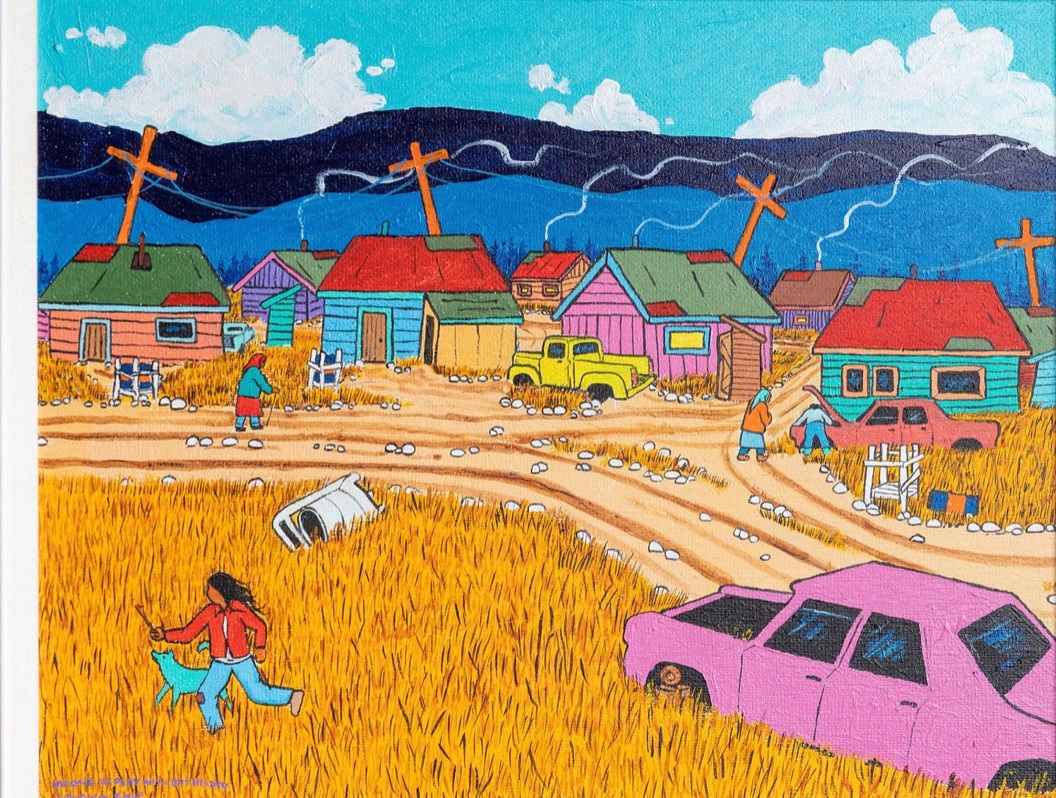
Look at Jim Logan’s painting (second painting at the top) 15 min
- In the foreground: a boy, a dog, tall yellow grass.
- On the right: an old pink car.
- In the background: small wooden houses, a yellow truck, hills.
Finish the sentences:
In the foreground, I can see a boy and his ________.
In the background, there are small ________.
The village might be in the ________ of Canada.
Nobody is ________ with the boy.
Answers
- dog
- houses
- north
- playing
The title and the artist 10 min
Title: No One to Play with but his Dog.
- Jim Logan is a Métis artist. He was born in 1955.
- He calls himself “a social statement artist”: his art speaks about society.
Is the boy happy or lonely? Why?
Answers
He looks lonely: he has no one to play with but his dog. But he is running, and the colours are bright.
The First Peoples of Canada 10 min
- The Constitution recognises 3 peoples: First Nations, Inuit, Métis.
- Treaty land: there was a treaty with the Crown.
- Unceded land: the land was never given up. This is the case of most of British Columbia.
Answers
Check: can you name the three peoples? First Nations, Inuit, Métis.
Sources: Justice Laws, section 35
A second painting: lines that connect 10 min
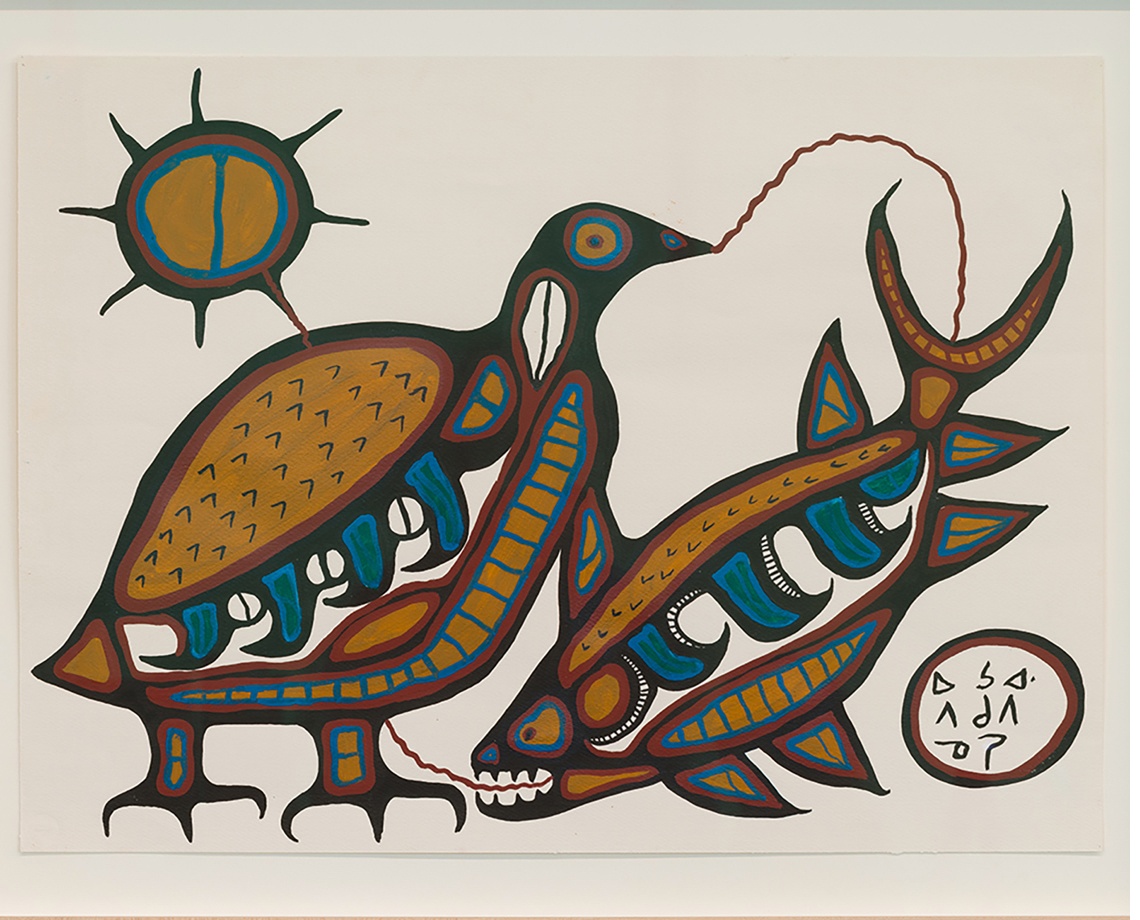
- In the top left-hand corner: a sun.
- On the left: a loon (a water bird). On the right: a fish.
- Red lines connect them. For Morrisseau, these lines “mark relationships”.
What do the red lines connect?
Answers
The sun and the loon, and the loon and the fish. They show that living things are connected.
Expanding your vocabulary
| Word | It means |
|---|---|
| kinship | a family-like bond |
| a living relative | treated as family, not as a thing |
| sacred | worthy of deep respect |
| interconnection | all living things are linked |
| X-ray style | we see the inside of the body |
| a resource | used for money or energy |
| stewardship | caring for the land for the future |
Observe the painting again 8 min
- Beings: a loon, a fish, a sun.
- Red lines join them.
- An X-ray view: we see colours inside the bodies.
- A circle with a signature in syllabics.
The bird is a ________.
The red lines join the sun, the loon and the ________.
The x-ray style shows the ________ of the animals.
Answers
- loon
- fish
- inside / inner life
Interpret with care 10 min
Careful language: say may, might, is often read as. We do not invent one fixed meaning for this painting.
- In Woodland art, lines often mark relationships.
- The x-ray style is often read as an inner life.
- Many Anishinaabe teachings speak of land and water as kin or living relatives.
- A place can feel almost sacred.
Finish:
The lines may mark ________ between living beings.
Land and water may be living ________.
This bond with the land can feel almost ________.
Answers
- relationships / interconnection
- relatives
- sacred
Connect: kin or resource? 8 min
- Kin: land and water as family; sacred places; stewardship for the future.
- Resource: land and water used for energy and money (dams, pipelines).
- Later sessions: James Bay, Muskrat Falls, Site C, Coastal GasLink, Trans Mountain.
Choose: if the river is kin, a dam is only / not only a resource project.
Answers
not only
Speak (45 to 60 seconds) 6 min
Write 60 to 80 words 12 min
Prompt: Why can nature hold a sacred place in Indigenous cultures, starting from this painting? Why does that matter for dams and pipelines?
Use 3 words: kinship, sacred, resource (or living relative, interconnection, stewardship).
In Morrisseau's painting, the loon and the fish are joined by ________.
This may show ________ between living beings.
For many First Nations, land and water are living ________.
A dam or a pipeline is not only a ________ project.
Answers
Sample ideas: lines / interconnection or relationships / relatives / resource.
Sample paragraph: In the painting, red lines join the sun, the loon and the fish. They may mark interconnection. The x-ray style might show an inner life. For many Anishinaabe teachings, land and water are living relatives, almost sacred. So a dam or a pipeline is not only a resource project: who decides must also hear that bond.
Building your vocabulary
| Word | It means |
|---|---|
| foreground / background | the front / the back of a picture |
| a reserve | land set apart for a First Nation |
| a treaty | an agreement with the Crown |
| unceded | never given up |
| a hereditary chief | a traditional leader |
| Woodland style | the style of Norval Morrisseau |
Homework
- Learn the kinship words and the First Peoples words.
- Finish your paragraph if you need more time.
- Write 5 sentences about Jim Logan’s painting. Start with: In the foreground…
Session 2: 1969, the White Paper
Equal citizens, or Citizens Plus?
Recap
- Name the three Indigenous peoples of Canada.
- What is unceded land?
Answers
- First Nations, Inuit, Métis.
- Land that was never given up by treaty.
The White Paper, 1969 15 min
- June 1969: the government of Pierre Elliott Trudeau publishes the White Paper.
- It was going to repeal (cancel) the Indian Act.
- It was going to abolish Indian status.
- The government said: we want equality.
Choose the right answer: the White Paper wanted to keep / end Indian status.
Answers
end
Sources: History of Rights
Watch: Harold Cardinal 10 min
Harold Cardinal became a leader at the age of ________.
His book is called The ________ Society.
Answers
- 23
- Unjust
The Red Paper, 1970 10 min
- The chiefs of Alberta answer with Citizens Plus, the Red Paper.
- Their idea: we are citizens, plus we have rights from the treaties.
- 1970: the government withdraws the White Paper.
Answers
Check: the White Paper was withdrawn in 1970.
Building your vocabulary
| Word | It means |
|---|---|
| to repeal | to cancel a law |
| to abolish | to end officially |
| status | a legal position with rights |
| to assimilate | to make a group lose its culture |
| to withdraw | to take back |
Debate in pairs 10 min
B: But the chiefs answered that they had rights from the treaties.
A and B: I agree with… because…
Homework
- Finish: First Nations rejected the White Paper because… (3 sentences).
Session 3: Rivers into Reservoirs
James Bay and the Cree.
Recap
- Give one key word about the White Paper.
- What was the Red Paper called?
Answers
- For example: 1969, status, Indian Act, withdrawn.
- Citizens Plus.
Watch: a deal in northern Quebec 15 min
Part 2, 1:36 to 2:30: the court and the agreement
Part 3, 2:30 to the end: what it changed
Part 1: In 1971, Premier Robert Bourassa forgot to ask the ________ and the Inuit.
Part 2: The agreement was signed in ________.
Part 3: The Cree and the Inuit received money and more ________.
Answers
- Cree
- 1975
- autonomy
Fort George 15 min
- 1979: the LG-2 dam starts.
- The river becomes twice as fast. The island is in danger.
- Nearly 2,000 people relocate to a new town: Chisasibi.
- Mercury rises in the fish.
Why did the people move?
Answers
Because the river became faster and the island was in danger.
Sources: CBC News, 11 November 2025
Grammar
Families used to paddle the river. (a habit in the past)
Building your vocabulary
| Word | It means |
|---|---|
| a dam | a wall across a river |
| a reservoir | an artificial lake |
| to flood | to cover with water |
| to relocate | to move people |
| mercury | a toxic metal |
| hunting grounds | land where people hunt |
Write a testimony (60 words) 10 min
I used to paddle the river with my ________.
Every summer, we would ________.
In 1979, we had to ________.
Homework
- Watch this video and note one positive and one negative opinion.
1:42 to 2:11: a young entrepreneur
2:11 to the end: Charlie Watt
Session 4: Dams Today
Muskrat Falls and Site C.
Recap
- What happens to the fish in a reservoir?
Answers
- Mercury levels can rise.
Muskrat Falls, Labrador 10 min
- A big dam in Labrador.
- The Inuit fear methylmercury in Lake Melville, downstream.
- A study said: up to 380 per cent more methylmercury.
- October 2016: the artist Billy Gauthier goes on a hunger strike.
Sources: CBC News, 2016
Watch: Billy Gauthier 10 min
0:57 to 2:05: his daughter, bravery
He drinks only ________.
His daughter loves ________.
Bravery is when you are ________ and you do it anyway.
Answers
- water
- fishing
- scared
Site C, British Columbia 15 min
- A dam on the Peace River. It has worked at full capacity since August 2025.
- Treaty 8 First Nations, like West Moberly, objected.
- 2022: West Moberly signs a partial settlement.
- BC Hydro says: clean energy for 500,000 homes.
1:48 to 2:03: not against development
Is Chief Roland Willson against all development?
Answers
No. He is against the destruction of the valley. He wants wind, solar or geothermal energy.
Sources: CBC News, 2025
Grammar
Flooding made mercury rise. The river became twice as fast.
Building your vocabulary
| Word | It means |
|---|---|
| downstream | further down the river |
| a hunger strike | not eating, to protest |
| a settlement | an agreement that ends a dispute |
| treaty rights | rights from a treaty |
| clean energy | energy that does not pollute the air |
| to object to | to be against |
A news flash (in groups) 10 min
Homework
- Finish: Hydroelectricity is / is not clean energy for everyone, because… (4 sentences).
Session 5: Pipelines on Unceded Land
Who speaks for the nation?
Recap
- Treaty land or unceded land: which one was never given up?
Answers
- Unceded land.
Coastal GasLink 10 min
- A gas pipeline of 670 km in British Columbia.
- 20 band councils said yes.
- Most Wet’suwet’en hereditary chiefs said no: the land is unceded.
- 2019 and 2020: police arrest protesters. 2023: the pipeline is complete.
Sources: CBC News, 2020
Watch: two leaders 15 min
1:24 to 1:52: John Horgan
Trudeau: a hundred years ago, nobody was ________.
Trudeau: Canada is a country of the rule of ________.
Horgan: the company signed agreements with every First ________.
Answers
- consulted
- law
- Nation
Trans Mountain 15 min
- 2018: the government buys the pipeline.
- 2018: a court says Canada did not consult properly.
- 2024: the pipeline starts.
- 2026: Ottawa offers First Nations a 15 per cent stake. Some say yes. One chief says: “consent is not for sale”.
0:43 to 1:29: a chief who wants the pipeline
Are all First Nations against the pipeline?
Answers
No. Some are against it. Others signed agreements and want the jobs.
Sources: Government of Canada · APTN News, 2026
Grammar
The company has to respect the law. The government ought to talk to the chiefs. Although the councils said yes, the chiefs said no.
Building your vocabulary
| Word | It means |
|---|---|
| consent | saying yes |
| a band council | an elected council |
| a hereditary chief | a traditional leader |
| an injunction | a court order |
| a blockade | blocking a road or a railway |
| a stake | a share in a project |
Role play 15 min
Homework
- Write 2 arguments for and 2 arguments against one pipeline.
Session 6: Promises Kept, Promises Broken
The promises and the figures.
Recap
- Consultation or consent: which one means “saying yes”?
Answers
- Consent.
The promise 5 min
- 2015: Justin Trudeau promises to end all long-term drinking water advisories by March 2021.
Watch: Neskantaga, 2020 10 min
0:57 to 1:40: the promise and the figures
The people of Neskantaga are in a ________, far from home.
Their advisory had lasted ________ years in 2020.
Answers
- hotel
- 25
The official figures, 21 October 2026 10 min
- 158 advisories lifted since November 2015.
- 39 advisories still in effect.
- in 37 communities.
- Neskantaga: boil water advisory since February 1995.
Was the promise kept? Choose: kept / partly kept / broken.
Answers
Partly kept: there was progress (158 lifted), but the deadline was missed (39 still in effect).
Sources: Indigenous Services Canada
Two opinions 10 min
0:31 to 0:57: David Chartrand
0:57 to 1:18: Lynne Groulx
Who is more positive: RoseAnne Archibald or David Chartrand?
Answers
David Chartrand: he says no prime minister has worked so much on Indigenous files.
- The government: more than 85 per cent of the 76 federal Calls to Action are completed or well underway.
- The Yellowhead Institute: only about 1 Call in 7 is fully complete (2024).
Building your vocabulary
| Word | It means |
|---|---|
| a pledge | a promise |
| a deadline | a final date |
| a drinking water advisory | a warning: do not drink the tap water |
| to lift | to end |
| to fall short of | not to reach |
Fact-check 10 min
The promise: ________.
What was done: ________.
What was not done: ________.
My verdict: kept / partly kept / broken.
Homework
- Adapted grammar page: do exercises 2 and 3.
Session 7: The Grizzlies
Youth, land and hope.
Recap
- Give one promise that was partly kept.
Answers
- Drinking water: 158 advisories lifted, but 39 still in effect.
The film 5 min
- The Grizzlies: a true story.
- 1998: a young teacher arrives in Kugluktuk, an Inuit community in Nunavut.
- He starts a lacrosse team with teenagers.
Watch: the director and the actors 20 min
This interview talks about hard subjects. Watch only the parts below.
1:28 to 2:15: the teacher and the students
4:47 to 5:12: hope
The teacher said: the kids changed him more than he ________ them.
“Broken ________ are dangerous here.”
Today, people are reclaiming their culture and their ________.
Answers
- changed
- promises
- language
Link with the painting 5 min
In the painting, the boy is alone. In the film, the teenagers become a ________.
Answers
team, a family
Grammar
Playing lacrosse gave them hope. They did not give up.
Building your vocabulary
| Word | It means |
|---|---|
| resilience | being strong after hard times |
| a role model | a person you want to imitate |
| to give up | to stop trying |
| to stand up for | to defend |
| self-determination | deciding for yourself |
Write a short review (80 words) 15 min
The Grizzlies tells the story of ________.
Playing lacrosse ________.
I liked ________ because ________.
Homework
- Choose your dossier for the final task with your group.
Session 8: Final Task
A Citizens’ Hearing.
Recap
- Name two dossiers of this unit.
Answers
- For example: the White Paper, the dams, the pipelines, water and the Calls to Action.
A Citizens’ Hearing on Broken Promises
Choose a dossier
Prepare 4 parts
- 1. The promise: who? what? when?
- 2. What was done: one figure and its source.
- 3. What was not done: one figure and its source.
- 4. Our recommendation: the government ought to…
Speak: 3 minutes per group 30 min
Write an open letter (150 words) 20 min
Dear Member of Parliament,
I am writing to you about ________.
The government promised that ________.
However, ________.
I ask you to ________.
Yours sincerely,
How you are assessed
| Criterion | Points |
|---|---|
| Content and sources | 6 |
| Language | 6 |
| Interaction | 4 |
| Respect for facts and points of view | 4 |
| Total | 20 |
Homework
- Give yourself a mark for each criterion.
- Write one sentence: What I will remember.